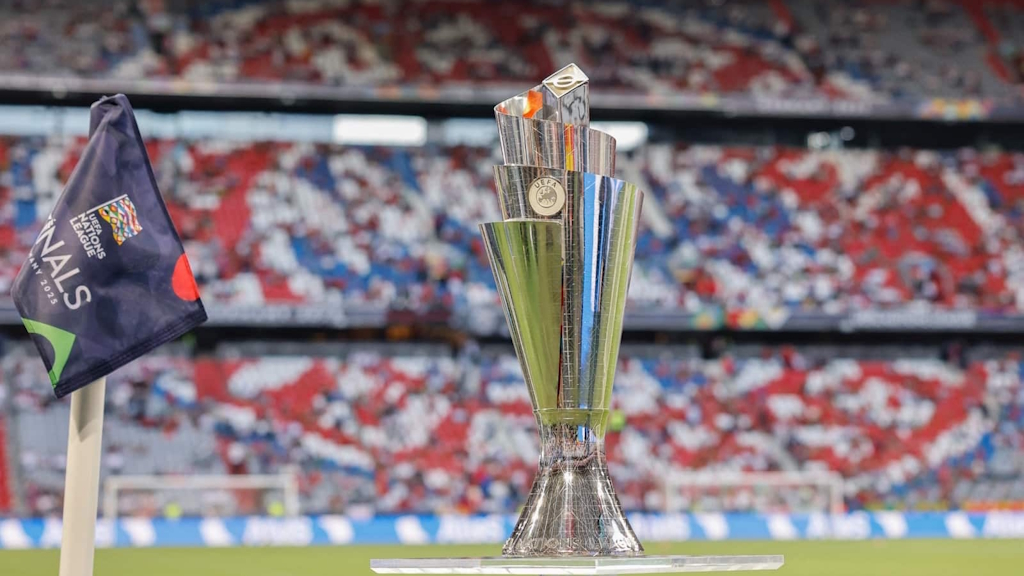
Before 2018, international football calendars were cluttered with friendlies that neither players nor fans particularly cared about. Top nations would use them to experiment, smaller nations would face mismatches, and the fixtures felt more like obligations than events. UEFA's answer was bold: a proper league competition, with promotion, relegation, and a path to the European Championship. The Nations League was born.
Four editions in, the competition has delivered drama that no one predicted. Spain have won it twice (and reached three finals), Georgia have climbed from League D to League B, and some of Europe's biggest names have suffered humiliating defeats on their own turf. The numbers tell a fascinating story.
660 Games: The Full Record
All results across all four editions and all league tiers (2018-2025)
The Champions
Portugal inaugurated the trophy in 2019 with Cristiano Ronaldo dazzling in Porto. France came from behind to beat Belgium and then Spain in 2021. Spain then took control, winning a penalty shootout against Croatia in 2023, and repeating the feat against Portugal in Munich in 2025 to become the only nation to lift the trophy twice. La Roja's dominance of this competition mirrors their wider golden generation.
 Portugal
1-0 vs Netherlands, Porto
 France
2-1 vs Spain, Milan
 Spain
Spain0-0 vs Croatia (pen.), Rotterdam
Spain2-2 vs Portugal (pen.), Munich
The Goal Machine
The competition has grown with each edition, both in games played and goals scored. The 2024/25 edition produced 344 group stage goals, more than any other, while the Finals in Germany delivered a stunning 5-4 semi-final between Spain and France. Here's how the goals have stacked up across each edition.
Four Leagues, Four Stories
The Nations League divides Europe's 55 teams into four tiers. League A features the heavyweights, but the data reveals something surprising: the top tier actually produces the least decisive results. With the best teams packed together, draws are more common and home advantage shrinks. League C, with its mid-ranked nations, is where goals flow most freely and upsets happen most often.
League A averages nearly 3 goals per game, the highest of any tier, driven by the quality of teams involved. But the away win rate in League A (34.1%) is the highest across all tiers, proving that at the top level, class can overcome home advantage.
Who Scores the Most?
Spain lead with 63 goals, powered by their three-final, 30-game Nations League journey. But look further down: Georgia (50 goals) and Kosovo (45 goals) sit among Europe's traditional giants. These smaller nations, playing with everything on the line in lower leagues, have turned the Nations League into a genuine platform for growth. Armenia (36 goals) have scored more than Croatia (35) in the competition's history.
The Nations League Climbers
The promotion system has given smaller nations something friendlies never could: a chance to prove they belong at a higher level. Georgia's rise from League D to League B is one of European football's great recent stories. They've won 15 of their 26 Nations League games, lost just 4, and their form in this competition was a springboard to Euro 2024 qualification. Kosovo, too, have climbed two tiers, winning 14 of 26 games against increasingly stronger opposition.
Georgia
W15 D7 L4
League D to League B
Kosovo
W14 D5 L7
League D to League B
North Macedonia
W10 D4 L8
League D to League C
Home Advantage: Fact or Fiction?
Home teams have won 43% of all Nations League games, a clear advantage but perhaps not as decisive as you'd expect. The inner ring shows the overall picture, while the outer ring breaks it down by tier. What emerges is a clear gradient: the lower the league, the stronger home advantage becomes. In League D, home teams win 43.3% and lose only 29.9%, while in League A, away teams win 34.1% of the time.
The explanation is intuitive. In League A, the quality gap between teams is smaller, so away teams can compete more evenly. In League D, home support and familiarity with conditions make more of a difference when technical ability is closer between sides.
Blowouts and Thrillers
The Nations League has produced some truly eye-popping scorelines. Germany's 7-0 demolition of Bosnia and Herzegovina in November 2024 is the competition's largest victory. Spain's 6-0 humiliation of Germany in Seville (2020) and Croatia (2018) remain iconic results. Each dot below represents a comprehensive result - the bigger the dot, the bigger the margin of victory.
Defining Moments
From shock upsets to nine-goal thrillers, the Nations League has delivered moments that would have been impossible in the old friendly format. Here are six games that defined the competition.
 England 1-2 Spain
Wembley, London - Edition 1 Group Stage
The Nations League's very first marquee fixture. England, fresh from their 2018 World Cup semi-final, hosted reigning champions Spain at Wembley. Luke Shaw scored England's opener, but Spain turned it around through Saúl and Rodrigo. The result announced that this competition meant something: Spain hadn't won at Wembley in 11 years, and now they had.
 Netherlands 3-0 Germany
Johan Cruyff Arena, Amsterdam - Edition 1 Group Stage
The Netherlands had failed to qualify for both Euro 2016 and the 2018 World Cup. They were a team in crisis. Then they beat Germany 3-0 in Amsterdam in one of the most electrifying Nations League nights. Virgil van Dijk and Memphis Depay inspired a performance that signalled the start of Dutch football's renaissance. Within months, they'd reach the Nations League final.
Spain 6-0 Germany
Estadio La Cartuja, Sevilla - Edition 2 Group Stage
Germany needed a draw to reach the Finals. They got annihilated. Ferran Torres scored a hat trick, Morata, Rodri, and Oyarzabal added the rest, and Germany suffered their heaviest defeat since 1931. Head coach Joachim Löw described it as "a black night." It remains one of the most stunning results in modern international football, and it happened in a competition critics once dismissed as glorified friendlies.
 Hungary 1-0 England
Puskás Arena, Budapest - Edition 3 Group Stage
Ranked 89th in the world, Hungary hosted 2nd-ranked England in front of 67,000 fans in Budapest. Dominik Szoboszlai inspired a 1-0 victory that set the tone for a remarkable group stage. It got worse for England: weeks later, Hungary won 4-0 at Molineux. Marco Rossi's side proved that the Nations League's tiered structure could produce genuinely competitive games at every level.
France 1-3 Italy

Parc des Princes, Paris - Edition 4 Group Stage
Italy went to Paris as heavy underdogs, ranked 38th against France at 5th. They won 3-1. It was the kind of result that simply wouldn't have happened in a friendly. Luciano Spalletti's young squad played with real intent and purpose, a performance born from the competitive stakes the Nations League provides. Italy would go on to a strong campaign, losing to Germany only on aggregate in the quarter-finals.
Spain 5-4 France
Mercedes-Benz Arena, Stuttgart - Edition 4 Semi-Final
Spain 5, France 4. Nine goals. A neutral venue in Stuttgart. This semi-final was everything UEFA hoped the Nations League could be. Two of Europe's greatest rivals traded blows in an astonishing game that swung back and forth. Spain's attacking flair ultimately prevailed, setting up a final against Portugal that went to penalties. It was the highest-scoring Nations League match ever played at knockout level.
Giant Killings: When Rankings Lie
One of the great things about the Nations League is that it consistently produces upsets you'd never see in friendlies. When something is on the line, lower-ranked teams raise their game. The chart below shows the biggest rank-gap upsets in the competition's history, where the winning team was ranked significantly lower than their opponent.
The red bars highlight the most dramatic upsets, where teams ranked 30+ places lower pulled off a victory. Hungary's wins against England, Kosovo's results against established nations, and the Faroe Islands' shock victory over Türkiye all demonstrate that the Nations League has given smaller nations the stage and the motivation to compete.
What Comes Next?
Edition 5 is set for 2026/27, with a format that continues to evolve. The promotion and relegation system ensures teams are always playing for something. Georgia's climb, Kosovo's emergence, and the Faroe Islands' giant-killing moments are the stories this competition was designed to create.
Explore every game, every result, and every statistic from all four editions of the UEFA Nations League in our full tournament explorer.
Data covers all 660 UEFA Nations League matches from September 2018 to March 2026, including group stages, knockout rounds, and promotion/relegation playoffs. Ratings and rankings are calculated by WFStats based on pre-match data.